Oct 27, 2026Custom Spout Pouch Guide
How to Choose a Spout Pouch Manufacturer: 10 Checks
Ten checks that separate a spout pouch factory from a trading company, what a real quotation must contain, and the answers that mean you should walk away.
How to Choose a Spout Pouch Manufacturer
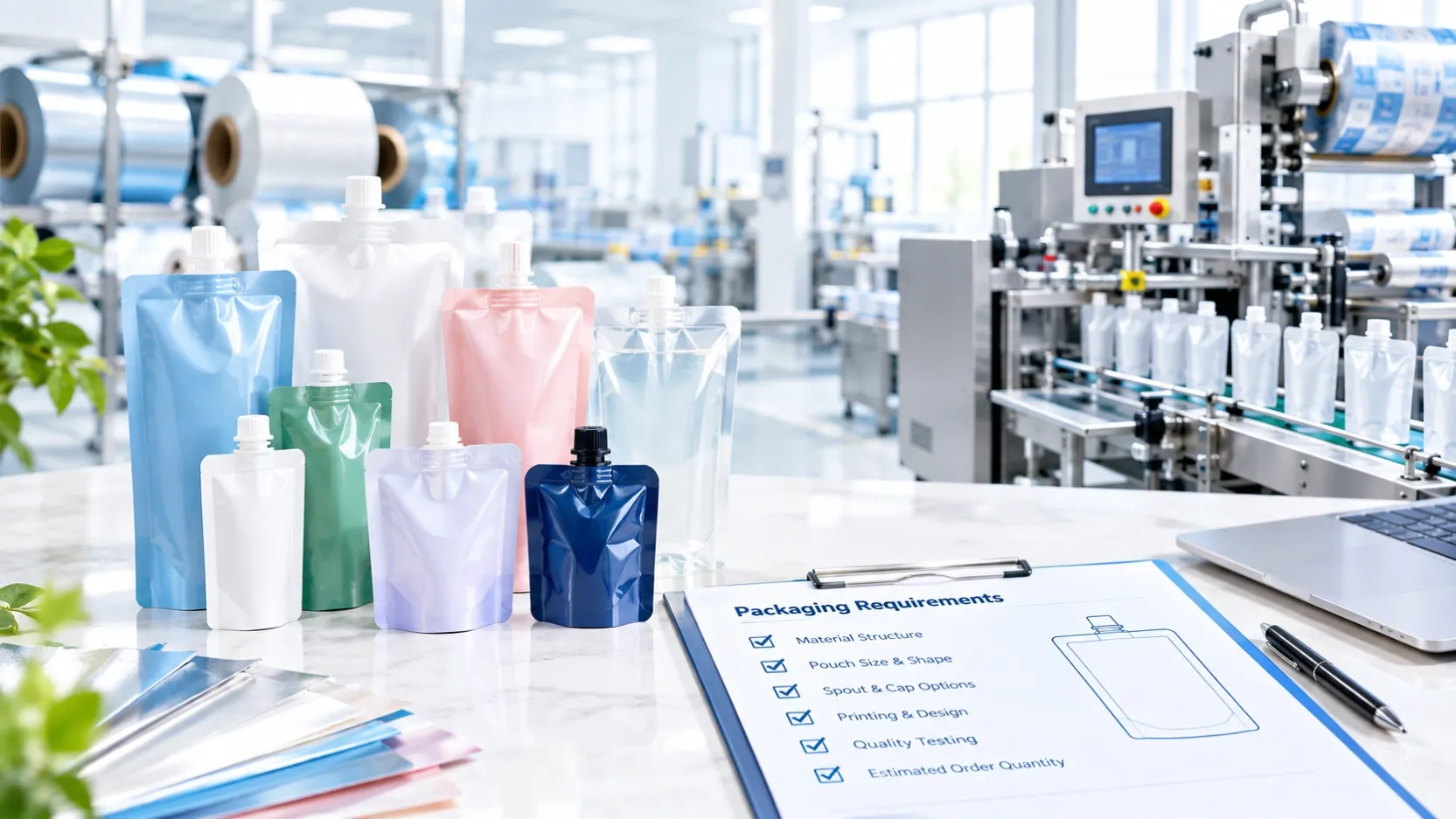
Most suppliers you meet at a packaging trade fair will describe themselves as a manufacturer. A good number are trading companies buying from the same handful of factories in Shantou and relabelling the result. The difference rarely shows up in the pouch itself — it shows up in who controls your delivery date, who can change a film structure mid-project, and who is accountable when a seal fails on your filling line.
This guide is ten checks, in the order we would run them if we were buying. Each one has an answer that tells you what you are dealing with.
Start with the question that ends most conversations
Ask which film structure they would put a 5% vitamin C serum in, and why.
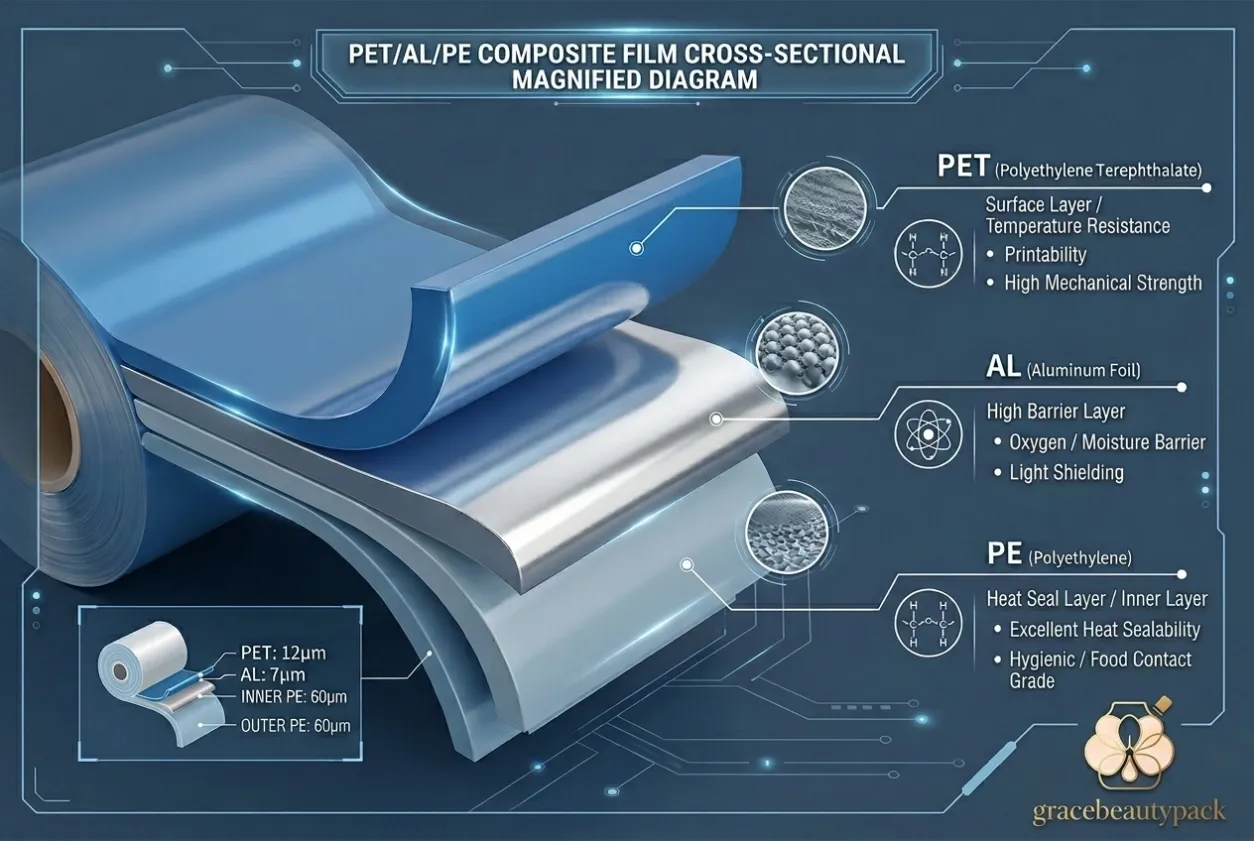
A factory answers in one sentence — PET/AL/PE, aluminium for oxygen and light barrier — and then asks about your shelf life target, because the answer changes the structure. A trader either forwards the question to someone else or answers "we can do any structure".
You do not need technical depth to run this test. You only need to notice whether the reply contains a decision. Our own cosmetic spout pouch manufacturing page lists the structures we would normally start from, which makes the comparison easy.
The ten checks
1. Do they recommend a structure before quoting a price?
A quotation that arrives with a price but no material specification is a price for an unknown product. Ask for the full structure — every layer, in order — before you compare numbers from two suppliers. If the second quotation is cheaper, it is usually a thinner film, not a better deal.
2. Do they ask about your filling line?
The first questions a factory asks are about your filling method, nozzle diameter and fill temperature. If you already run a line, those three answers determine the spout bore and the seal specification. A supplier who never asks is planning to send you whatever is in stock.
3. Can they name the spout bore in millimetres?
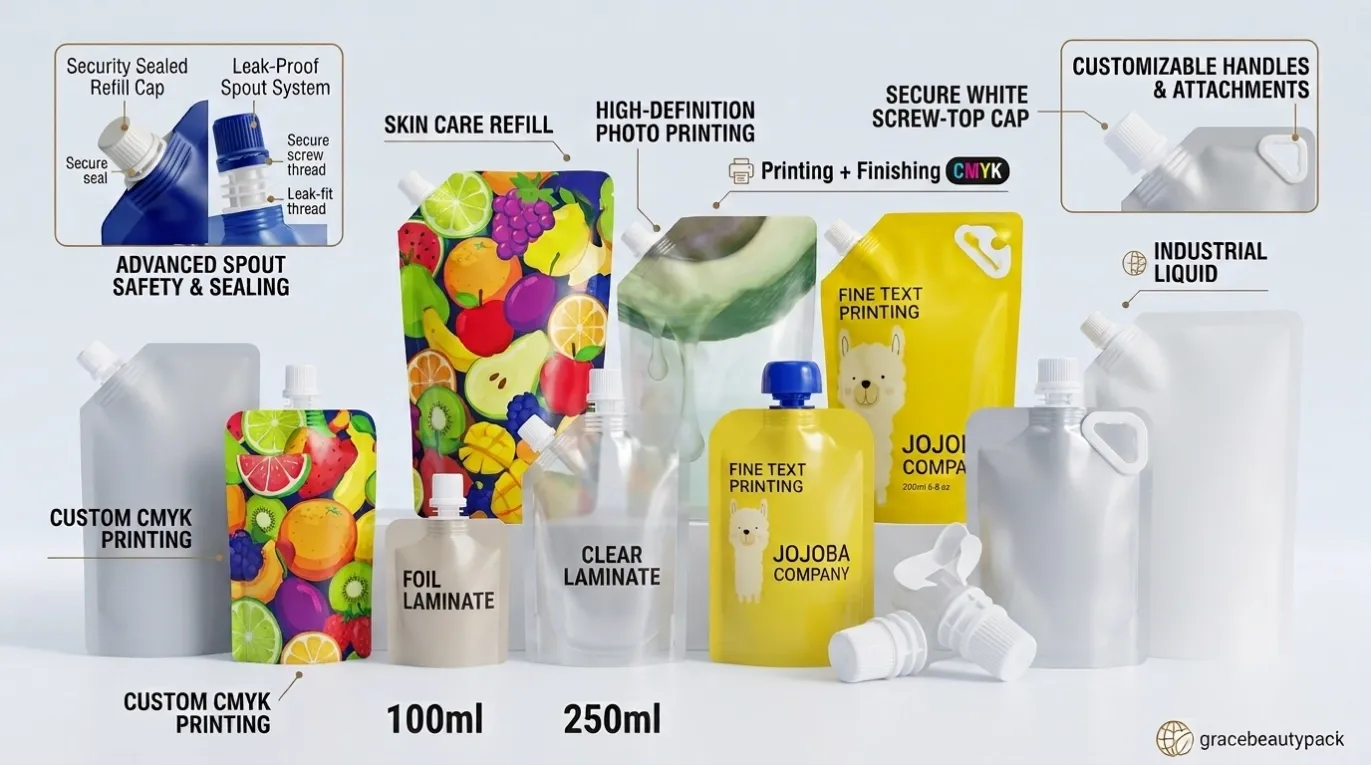
"Custom spout" is not a specification. Ask for the bore in millimetres and the position — top-centre or corner. Corner placement is for thick products that need gravity to empty the last of the fill; top-centre is the default for upright retail formats. If nobody can put a number on it, nobody can guarantee it fits your nozzle.
4. Do they send a specification sheet or a number?
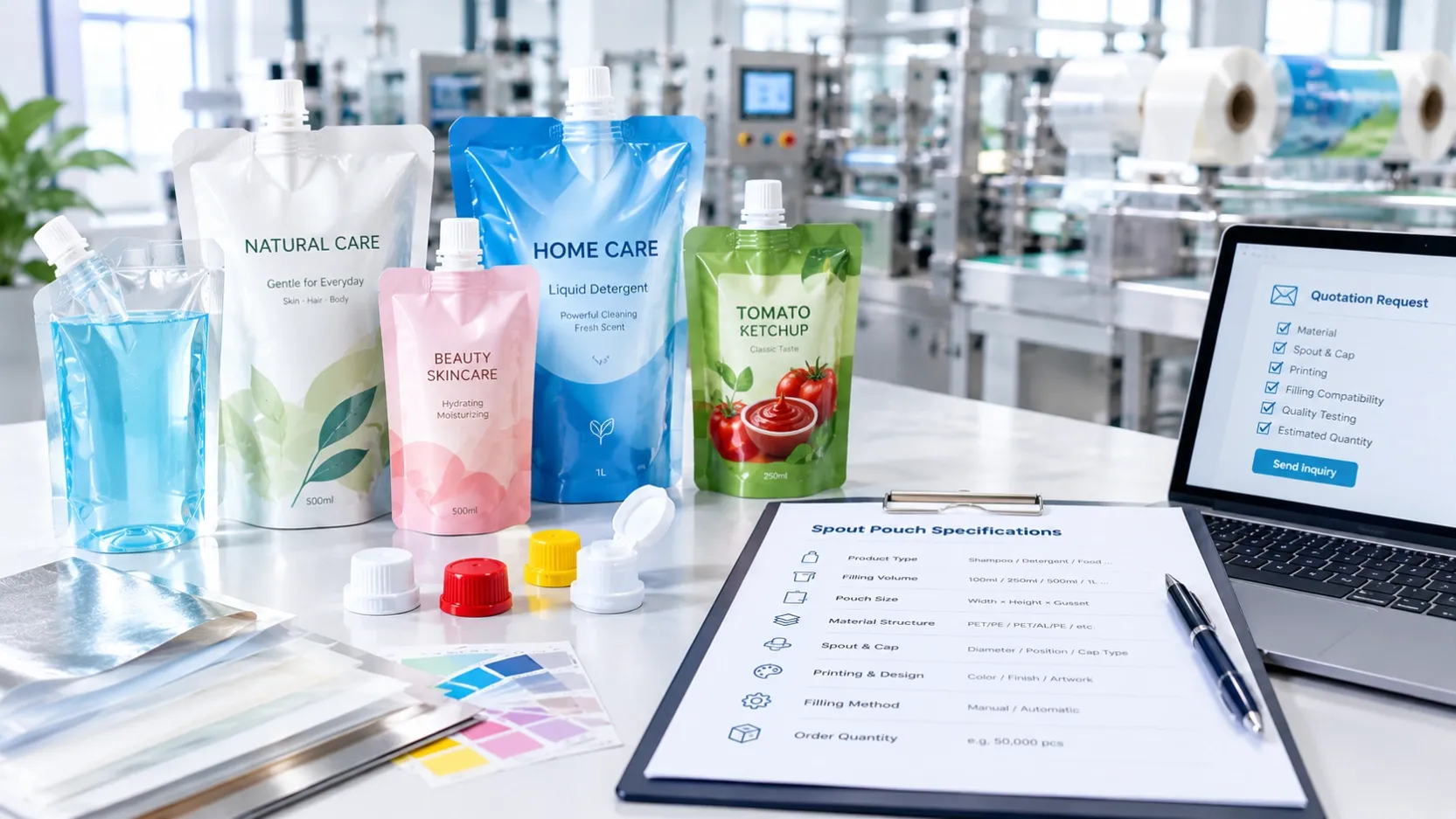
A proper quotation is a document. Ours lists material structure, pouch dimensions, spout bore and position, cap type, print method and colour count, MOQ, sampling time, production time and payment terms. If yours is a single figure in a chat message, you cannot compare it to anything.
5. What is the real MOQ, and is the trial batch real?
MOQ is where most first orders die. Our standard is 10,000 pcs per design, with a 1,000-pc trial batch available on a single design so you can check appearance, print and capacity before committing.
Be careful with suppliers who quote a low MOQ to win the enquiry and raise it once the artwork is approved. Ask for the MOQ in writing, per SKU, before design work starts.
6. Will they send a filled sample, or only an empty one?
An empty pouch tells you how the film feels. It tells you nothing about whether the spout-to-film seal holds your product, whether the pouch stands when filled, or whether your nozzle fits. Ask for a filled sample with your actual formula, or the closest representative one they can run.
Stock samples are free from us — you cover freight only, dispatched the same day the freight payment arrives. Details are on our free stock samples page.
7. Which tests run on every batch, and which run only on request?
Every batch we produce is leak-tested and seal-tested. Beyond that, a new structure should be checked for heat-seal strength, spout-to-film seal integrity, cap closure torque, leak resistance under compression and transit performance.
The distinction that matters: which of these are routine, and which cost extra. A supplier who cannot answer that has not thought about failure modes.
8. Who pays when a seal fails?
This is the question nobody asks until it is expensive. If 20,000 pouches leak on your filling line, the cost is not the pouches — it is the product inside them, the line downtime and the launch date.
Ask directly: if the failure traces to a seal that did not meet the agreed specification, who absorbs the cost? Get the answer before the purchase order, not after.
9. What does their artwork check actually catch?
Send a test file at the dieline stage and see what comes back. A factory checks bleed, seal-zone clearance and minimum type size — the three things that ruin a print run. A trader forwards your file and says "looks fine".
Seal-zone clearance is the one buyers most often miss: artwork that runs into the seal area will be crimped, and on a spout pouch that area is not small.
10. What do they refuse to make?
A supplier who says yes to everything has not understood your project. Film structures have limits — some products attack certain adhesives, some fill temperatures exceed what a given laminate tolerates, some shapes cannot hold a bottom gusset at the size you want.
A straight "that will not work, here is what will" is worth more than any quotation.
What a quotation should contain
Compare suppliers on the document, not the bottom line. If two quotes differ, this is where you find out why.
Item | What to expect |
|---|---|
Material structure | Every layer, in order (e.g. PET/AL/PE ) |
Pouch dimensions | Width × height × bottom gusset, in mm |
Spout | Bore in mm, position, cap type |
Printing | Method, number of colours, finishes available |
MOQ | Per design, per SKU |
Sampling | Stock lead time and custom print lead time |
Production | Working days from deposit and artwork approval |
Payment | Deposit percentage and balance terms |
Testing | Routine tests and optional tests |
If a quote is missing half of this table, the price is not comparable — it is a different product.
Five answers that mean walk away
- "Any structure is fine." No factory says this. Film choice is the whole job.
- "We can match any MOQ." Volume changes the plate cost and the setup; nobody can match any number profitably.
- "Samples are charged, non-refundable, 3 weeks." Sampling that slow usually means the samples are being bought elsewhere.
- "We will confirm the specification after you pay the deposit." The specification is what you are paying for.
- "That is normal for pouches." When you raise a leak or a print defect, this sentence means nobody is going to fix it.
What working with us looks like
Grace Beauty Pack has been making flexible packaging in Shantou, Guangdong since 2008. The factory is ISO 9001 and ISO 22000 certified and produces 5 million pouches a month.
- MOQ — 10,000 pcs per design, with a 1,000-pc trial batch on a single design
- Sampling — stock samples free, dispatched the same day freight is paid; custom printed samples in 7–10 days
- Production — 15–20 days after deposit and artwork approval
- Payment — T/T, 50% deposit, balance before shipment
Typical projects: skincare refill spout pouches, shampoo refill pouches, travel sizes, and private-label programmes across cosmetic, home care and food.
If you are still shaping the specification, send the product type and target fill volume — the pouch size, material and spout follow from those two.
FAQ
Is a trading company always a bad choice?
Not always. A good trader with factory relationships can be efficient for small, standard orders. The problem appears when you need a structure change, a fast delivery date, or someone to take responsibility for a failure. At that point the chain of blame gets long and your launch date is the casualty.
How long does it take to get a sample?
Stock samples ship the same day we receive the freight payment. Custom printed samples take 7–10 days, because plates have to be cut and the print run scheduled. If you need two structures or two spout positions to compare, tell us at the request stage so they run together instead of as separate rounds.
What is the minimum order?
10,000 pcs per design. A 1,000-pc trial batch of one design is available if you want to check the finished pouch before committing to a full run.
Next step
Send your product type, fill volume, viscosity and target quantity. If you have a filling line, include the nozzle diameter — it determines the spout. We reply with a specification sheet and a quotation.